
GREENFIN KENYA Project
Projects
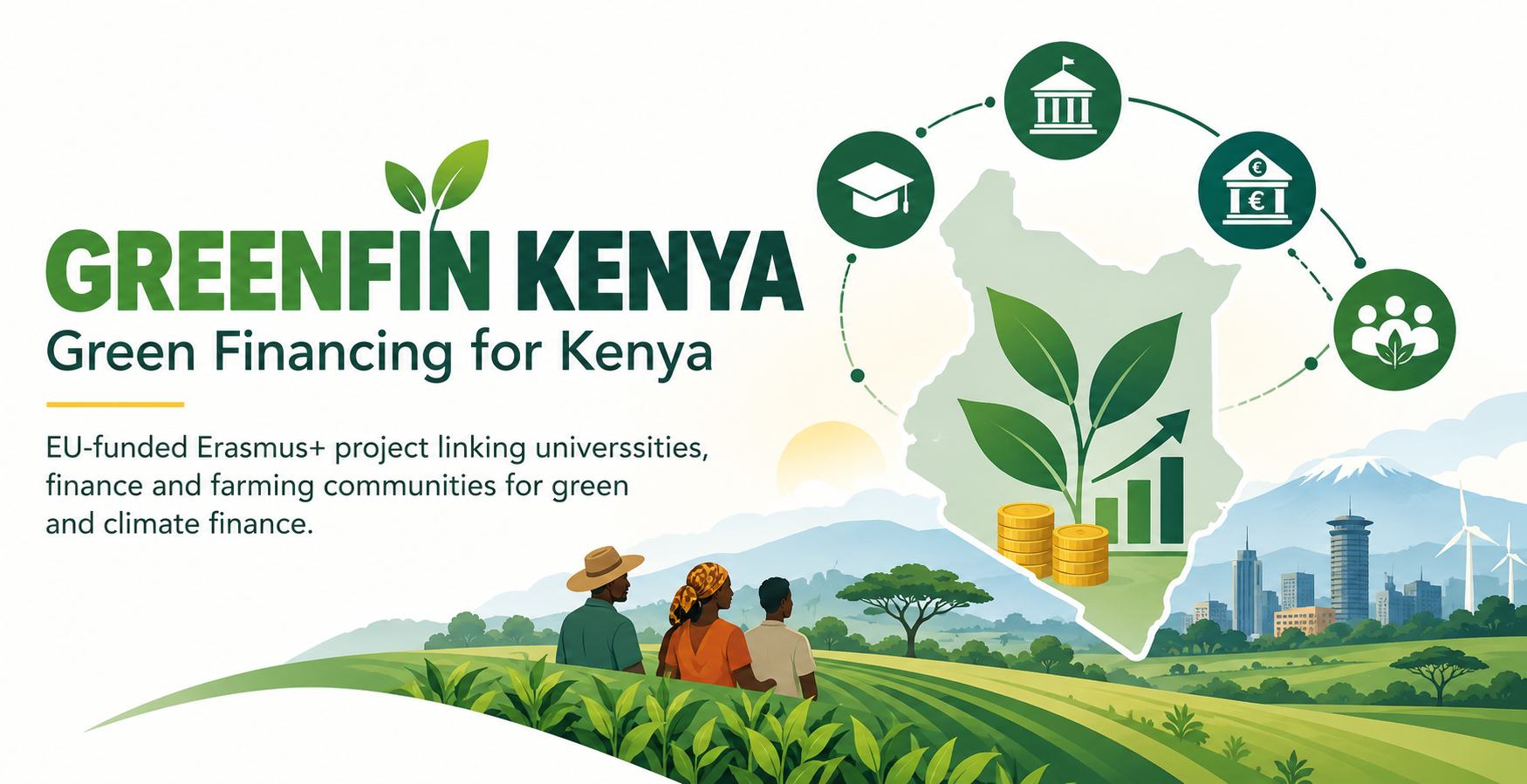
Green Financing for Kenya (GREENFIN KENYA) is a European Union funded Erasmus+ project that brings universities, government, financial institutions and farming communities together to strengthen green and climate finance in Kenya. Jaramogi Oginga Odinga University of Science and Technology (JOOUST) is a beneficiary partner and leads the work on mapping the green finance landscape and developing the evidence needed for education and policy reform.
The project connects university teaching and research with practical financing needs in agriculture. It will develop green finance education, support policy coordination and design tools that help financial institutions assess smallholder farming businesses, with particular attention to women and young people.
Project at a glance
| Item | Details |
| Project title | Green Financing for Kenya |
| Acronym and grant number | GREENFIN KENYA | 101323998 |
| Funding programme | European Union Erasmus+ Capacity Building in Higher Education Strand 3 Structural Reform | Sub-Saharan Africa |
| Granting authority | European Education and Culture Executive Agency (EACEA) |
| Implementation period | October 2026 to September 2030 | 48 months |
| Consortium coordinator | South Eastern Kenya University (SEKU), Kenya |
| Total EU grant | EUR 963,704.92 |
| Partnership | 11 beneficiary institutions and 1 associated partner across 5 countries |
Project objectives
The project aims to strengthen a resilient and inclusive green finance ecosystem in Kenya through three objectives:
- Strengthen the capacity of Kenyan universities to design, deliver and govern relevant education programmes in green banking and climate finance.
- Support coordinated reforms across higher education, agriculture, climate finance and financial regulation.
- Improve smallholder farmers’ access to green finance through suitable financial product models and stronger institutional linkages, with a focus on women and youth.
JOOUST role in the project
JOOUST will contribute to all six work packages. Its main responsibilities combine evidence generation, professional education and the development of practical tools for agricultural finance.
Leading green finance landscape and roadmap mapping
JOOUST leads Work Package 2, working with the Ministry of Education and other partners to assess Kenya’s green and climate finance ecosystem. This work will map institutions, policies, projects and existing investments, examine university governance and curricula, and identify gaps in skills and institutional capacity. JOOUST will also coordinate assessment activities and benchmark practices in Europe and East Africa. The findings will inform the reform roadmap for green finance education and the national framework of green finance competencies.
Developing digital green finance skills
JOOUST will coordinate the development of the Digital Green Finance Specialist professional micro-credential. It will also contribute to Green Banking and Climate Finance study tracks at bachelor’s and master’s levels, teaching materials and training for university staff and financial sector professionals. Courses and study tracks will follow the relevant institutional and accreditation procedures before delivery.
Strengthening smallholder financial risk assessment
Under Work Package 4, JOOUST will work with partners on a business analysis tool and risk assessment methodology suited to smallholder farming. The tools will consider farm costs, revenues, cash flow and investment risks to support more informed financing decisions. JOOUST leads the deliverable on standardised risk scoring methodology and an assessment toolbox, including the supporting data collection approach.
Connecting research with communities and policy
JOOUST will contribute to consultations with farmers, agribusinesses, financial institutions and public authorities, and participate in testing and refining the project’s tools. Its wider contribution will include financial literacy and digital readiness activities, policy dialogue, dissemination and monitoring of implementation. Gender equality and the participation of women and youth will inform these activities.
Key deliverables led by JOOUST
| Reference | Deliverable | Due |
| D2.1 | National Green Finance Skills and Policy Diagnostic Report | Month 6 |
| D2.2 | Benchmarking report on green finance and climate finance practices | Month 6 |
| D4.2 | Standardised risk scoring methodology and assessment toolbox | Month 18 |
Project months are counted from October 2026. These outputs will provide evidence for subsequent education, policy and financing activities.
Project activities and expected benefits
GREENFIN KENYA is organised into six work packages. The sequence connects assessment and education reform with the development of financing tools, policy engagement and wider use of the results.
| Work package | Focus | Lead partner |
| WP1 | Strategic coordination and quality assurance | SEKU |
| WP2 | Green finance landscape and roadmap mapping | JOOUST |
| WP3 | Next generation green finance education and training | The Co-operative University of Kenya |
| WP4 | Smallholder access to finance through data driven risk assessment | HSWT |
| WP5 | Green finance policy alignment with the EU Taxonomy | Maseno University |
| WP6 | Project communication, dissemination and exploitation of results | Farming Systems Kenya |
Why the project matters
Smallholder farmers can face difficulties obtaining finance when loan conditions, collateral requirements and repayment schedules do not match their farming businesses. Limited financial literacy, climate risks and gaps in digital access can make these difficulties greater for women and youth. At the same time, universities and financial institutions need stronger capacity to teach and apply green finance. GREENFIN KENYA will address these connected needs through education, research and collaboration with the institutions that shape lending and investment decisions.
Who will benefit
- Students and university staff will gain access to new study content, professional development opportunities and practical approaches to teaching green and climate finance.
- Smallholder farmers, women and youth will be engaged in activities that strengthen financial literacy, digital readiness and links with appropriate finance and advisory services.
- Financial institutions and agricultural advisors will contribute to the development and validation of tools for assessing farming businesses and designing suitable financing models.
- Policymakers and regulators will receive diagnostic evidence, reform proposals and opportunities for dialogue on a more coordinated green finance system.
Expected results and lasting benefits
Expected outputs include new study tracks and micro-credentials, trained educators, GreenFin Training Centres of Practice, a Virtual GreenFin Knowledge Hub, and tested analytical and financial product models. The project will also develop a context appropriate green finance taxonomy for East Africa, drawing on the EU Taxonomy, which classifies environmentally sustainable economic activities.
By embedding teaching materials, skills and institutional partnerships within participating universities, GREENFIN KENYA aims to sustain these benefits beyond the funding period. JOOUST’s participation will strengthen the links between its teaching, applied research and engagement with farming communities.
JOOUST project team
The JOOUST team brings expertise in agribusiness, sustainable food systems, economics, digital technology and project management.
| Photograph | Team member and expertise |
 |
Dr. Mary Orinda
Project Investigator Agrobiodiversity, circular bioeconomy, sustainable value chains and farmer entrepreneurship capacity building.
|
 |
Prof. Christopher Gor
Co-Principal Investigator Agribusiness, green finance and policy, with experience in fisheries, irrigation and climate smart investment portfolios. |
 |
Mr. Samuel Ohanga
Project Manager Project coordination, implementation support, monitoring and evaluation, and reporting. |
 |
Prof. Arvinlucy Onditi
Member Business management and consumer behaviour, with expertise in sustainable business models, food systems and waste to value enterprises. |
 |
Dr. Lydia Nyambok
Member Agricultural economics, applied econometrics, food systems and climate change research. |
 |
Mr. Joseph Aguk
Member Sustainable food systems, green value chains, digital agricultural markets and climate smart agribusiness. |
 |
Mr. Donatus Abwao
Member Software engineering and e-learning, including artificial intelligence integration, digital platforms and application development. |
Project partnership
The consortium combines Kenyan higher education, government and financial sector experience with European expertise in agricultural education, green finance and institutional development. SEKU coordinates the project. STIHL East Africa Limited participates as an associated partner.
| Institution | Country | Participation |
| South Eastern Kenya University (SEKU) | Kenya | Coordinator |
| Maseno University | Kenya | Beneficiary |
| Jaramogi Oginga Odinga University of Science and Technology (JOOUST) | Kenya | Beneficiary |
| The Co-operative University of Kenya | Kenya | Beneficiary |
| Ministry of Education, Science and Technology | Kenya | Beneficiary |
| Association of Microfinance Institutions | Kenya | Beneficiary |
| Farming Systems Kenya | Kenya | Beneficiary |
| Weihenstephan-Triesdorf University of Applied Sciences (HSWT) | Germany | Beneficiary |
| Wroclaw University of Environmental and Life Sciences (UPWr) | Poland | Beneficiary |
| Western Balkans Institute (WEBIN) | Serbia | Beneficiary |
| OBREAL Global Observatory | Spain | Beneficiary |
| STIHL East Africa Limited | Kenya | Associated partner |
Engagement and enquiries
For enquiries about JOOUST’s participation in GREENFIN KENYA, please contact the Directorate of Research, Innovation and Extension, Jaramogi Oginga Odinga University of Science and Technology, Bondo, Kenya. The JOOUST project team will coordinate engagement with university staff, students and relevant external stakeholders.
Funding acknowledgement
GREENFIN KENYA is funded by the European Union through the Erasmus+ Capacity Building in Higher Education programme under Grant Agreement 101323998. The European Education and Culture Executive Agency (EACEA) is the granting authority.
Funded by the European Union. Views and opinions expressed are however those of the author(s) only and do not necessarily reflect those of the European Union or the European Education and Culture Executive Agency (EACEA). Neither the European Union nor the granting authority can be held responsible for them.